Pescasseroli: a guide to the village, its history and the best hikes in the Abruzzo National Park

At 1,167 metres above sea level, in the heart of the Alta Valle del Sangro, Pescasseroli is the village that gave birth to the Abruzzo, Lazio and Molise National Park — and remains its beating heart to this day.

Surrounded by mountains rising above 2,000 metres, by ancient beech forests and wide open pastures, this small centre carries a history as long as the mountains that shelter it: from prehistoric settlement to Lombard courts, from the drove roads of transhumance to the vision of one man who, in the early 1920s, drew the future of an entire territory.

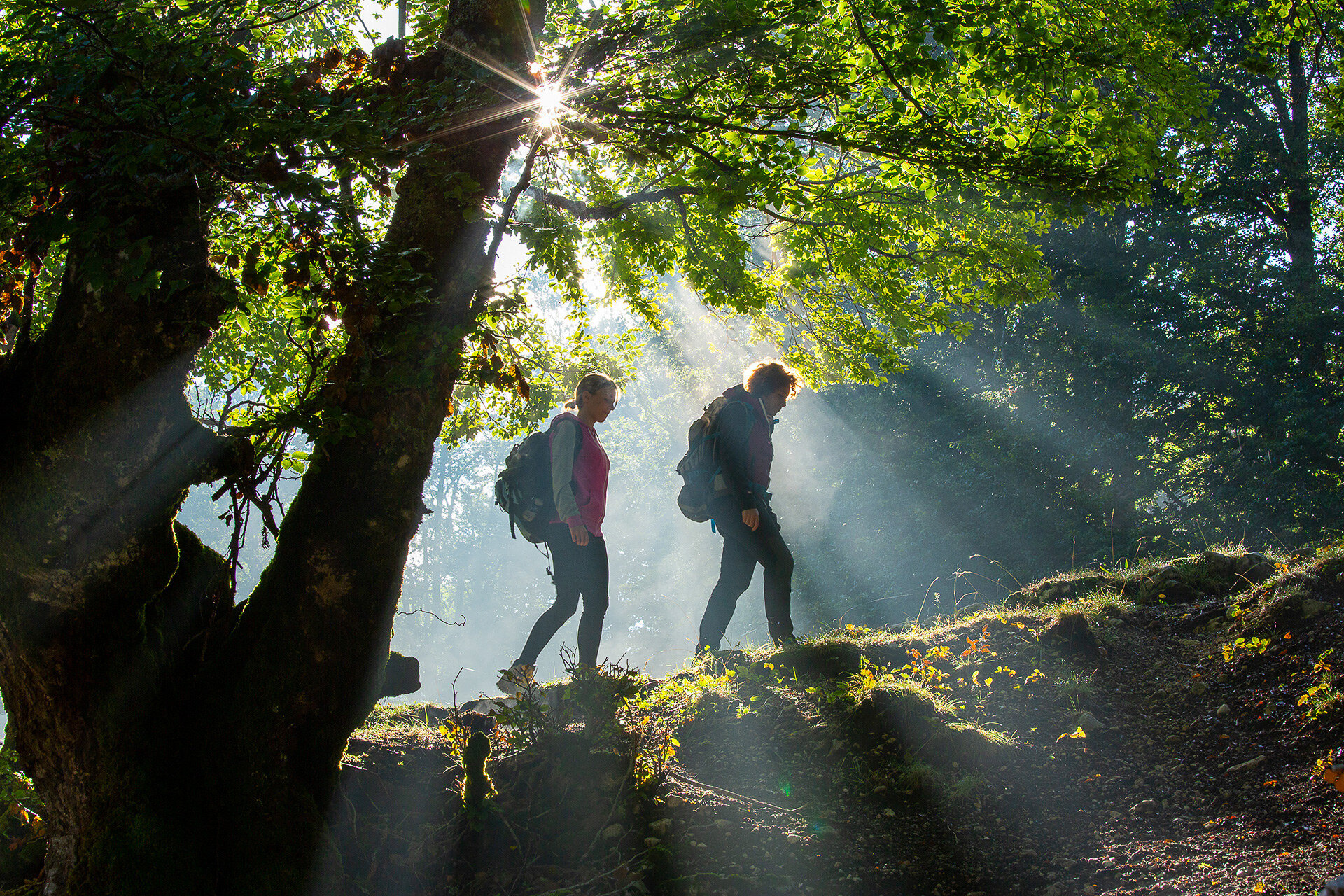
Guided hike through La Difesa di Pescasseroli, an ancient wooded pasture with monumental candelabra-shaped beech trees in the Abruzzo, Lazio and Molise National Park | © Bruno D'Amicis - Wildlife Adventures

Pescasseroli is far more than a convenient base for exploring the Abruzzo, Lazio and Molise National Park. It is a place with a deep identity, shaped by ancient traditions, by a pastoral culture still visible in its traces, and by a relationship with nature that here has never been a mere tourist invention.

In this guide we take you through the history of Pescasseroli, its origins and the figures who shaped it — before leading you to everything the village and its surroundings have to offer today: guided excursions in the Park, wildlife watching, mountain refuges and trails through landscapes you will not easily forget.

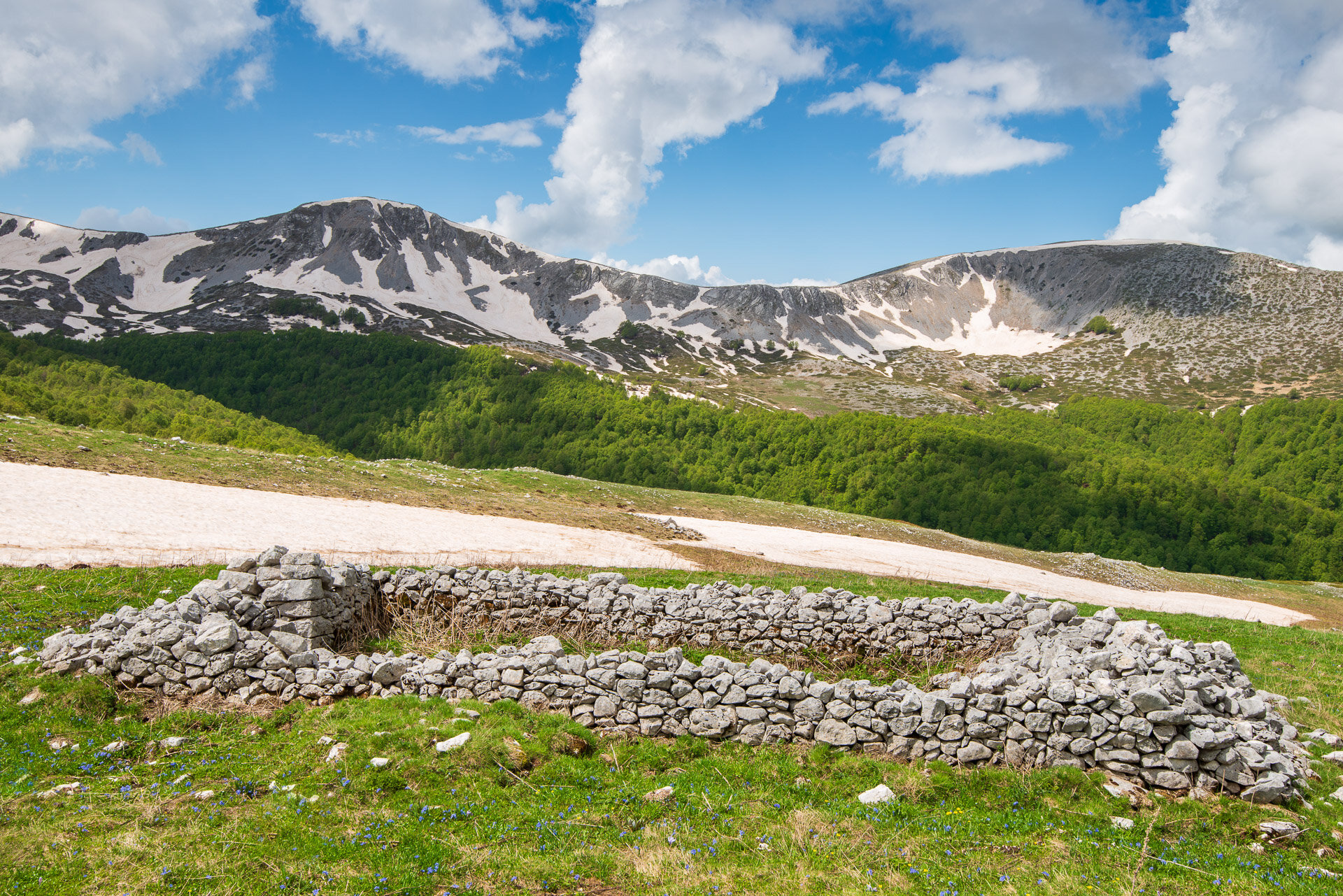
The natural amphitheatre of Valle di Corte and the remains of a summer shepherd's shelter, in the heart of the Abruzzo, Lazio and Molise National Park | © Umberto Esposito - Wildlife Adventures

The history of Pescasseroli

The origins of the name: between history and legend

The name Pescasseroli appears in written records for the first time in 820, when the Regesto of the Sabine monastery of Farfa mentions a curtem quae vocatur Serule in the area of what is now the church of Santi Pietro e Paolo. In subsequent medieval documents the village appears as Pesculum Serulae (1114), Pesculum Asseroli (1247), Pesculum Seroli (1296) and Pesculum Asseruli (1324): a gradual fusion of two Latin nouns compressed by the centuries into a single name.

The first element — Pesculum, still preserved in the local dialect as Péschë — derives from the medieval Latin pesclu(m), meaning "rocky peak". The second, Serulae, has more disputed origins: some linguists trace it to *serula, a diminutive of sera ("a bar for closing a door"), preserved in the seventeenth-century Aretine dialect as sierla ("latch, lock"). Benedetto Croce proposed a different interpretation, linking the name to the small watercourse known as Sarolum — the Sangro in its nascent form, rising close to the village, "still poor in water, still small".

Alongside the documented history lives an older legend, passed down in verse by the shepherd-poet of Pescasseroli Cesidio Gentile, known as "Jurico". Set at the time of the First Crusade, it tells of Seroli, the young son of Count Marrucino, lord of Castel Mancino, who leaves for the Holy Land and there meets the beautiful Pesca. The two fall in love and marry, but on his return home the old count claims the young bride for himself. Pesca flees and takes her own life at a spring — which to this day bears the name Fonte di Malafede — and Seroli, upon learning of his beloved's death, ends his own life in her arms. The old count, in a sign of repentance, had a village built over the lovers' tomb, naming it in their memory Pescasseroli. First brought to wider attention by Benedetto Croce, the legend has enjoyed enduring popular appeal.

From prehistory to Roman rule

The earliest evidence of human presence in the Alta Valle del Sangro dates to the Upper Palaeolithic. Permanent settlement in the area of Pescasseroli is documented from the first millennium BC, with traces of walled enclosures in the locality of Colle della Regina. With the end of the Samnite Wars the territory was assigned to the Sergia tribe of the Marsi, in the fourth Augustan region of Sabina et Samnium. During the Republican and Imperial periods several fundi — rural estates belonging to prominent families — arose in the area, and according to the historian Giuseppe Grossi a Roman villa stood in what is now the historic centre, where the local historian Gianluca Tarquinio more recently identified ancient tombs.

The Middle Ages: monasteries, castles and feudal families

In the early Middle Ages real power was exercised by the Benedictine monks, who intensified their presence in the territory following the conversion of the Lombard population in the seventh century. The territory between Opi and Barrea was long contested between the Diocese of the Marsi and the monasteries of Montecassino and San Vincenzo al Volturno.

Between the tenth and eleventh centuries the phenomenon of incastellamento — the concentration of the population on defensible hilltop sites — led to the construction of the ring-castle of Pesculum, the present-day Castel Mancino, which was progressively abandoned in favour of the lower-lying settlement of Serulae, from which the modern village developed.

In 1017 the Lombard princes of Capua donated control of the valley to the abbot of Montecassino, consolidating Cassinese authority over the Alto Sangro. Episcopal power was soon displaced, however, by the great feudal families: first the Borrello, of Frankish origin, who controlled Pescasseroli and Opi in the eleventh century; then the Di Sangro, of probable Lombard descent; and finally the Normans under Roger II (1139–1143), who annexed the Marsica to the Kingdom of Sicily. In the following centuries the village passed to the Swabians, then to the Angevins — who in 1273 created the Justitiaratus Aprutii — and subsequently to the D'Aquino (1283) and finally to the counts D'Avalos (1461).

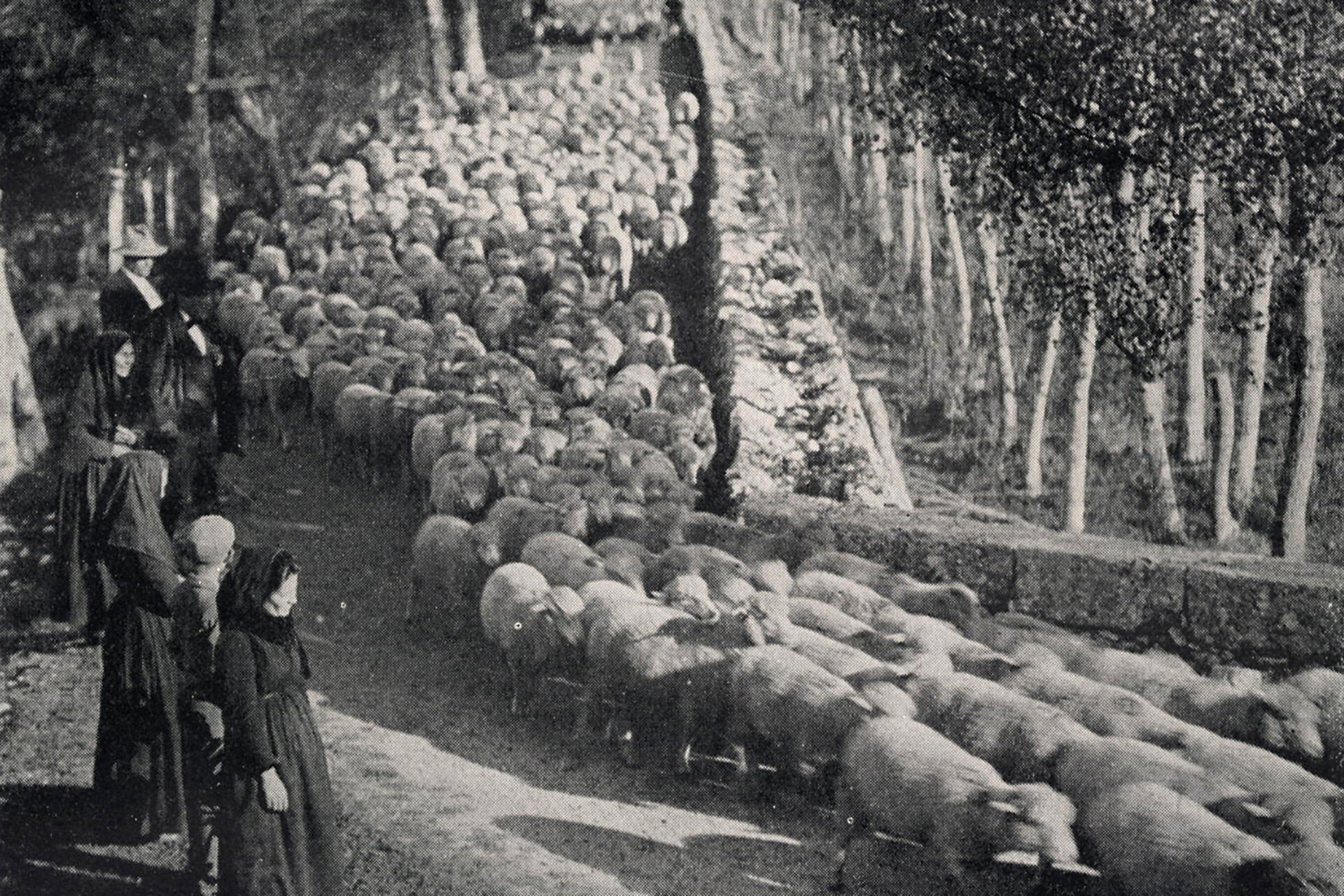
Historical photograph of women waiting at the starting point of the Pescasseroli–Candela drove road, one of the main transhumance routes connecting the Central Apennines to the Tavoliere delle Puglie | © Archivio Parco Nazionale d'Abruzzo, Lazio e Molise

The Sheep Customs House and the Tratturi

Following the reorganisation carried out by the Aragonese administration, the livestock industry represented the principal source of income for the mountain communities of Abruzzo. Pescasseroli became a full participant in the economic system that would dominate the whole of southern Italy for more than three centuries: the Aragonese transhumance regulated by the Dogana della mena delle pecore di Foggia — the Royal Customs House for the movement of sheep.

Established by Alfonso I of Aragon in 1447, the Customs House was one of the most sophisticated fiscal and administrative systems in medieval Europe: a state within a state, capable of managing the seasonal movement of millions of sheep between the summer pastures of the Apennines and the winter grazing grounds of the Tavoliere di Puglia. The mechanism was simple in its logic and extraordinary in its scale: in summer the flocks moved up to high altitude — into the mountains of the Abruzzo, the Majella and the Matese — and in autumn they descended to the plains along the tratturi, grassy drove roads up to 111 metres wide, recognised and protected by the law of the kingdom.

Pescasseroli was one of the starting points of the Regio Tratturo Pescasseroli–Candela, which over its more than 200 kilometres connected the Alta Valle del Sangro directly to the heart of the Apulian plain. This was no ordinary track: it was one of the principal arteries of the entire system, and Pescasseroli was its mountain terminus. This meant that the village was, by definition, a place of departure and return, of contracts and encounters, of fairs and exchanges.

The local economy, culture and even the festive calendar were shaped by the movements of the flocks. The Customs House system profoundly transformed the social landscape of the Alta Valle del Sangro. Alongside the transhumant shepherds — often drawn from many different provinces of the kingdom — there developed a network of economic and professional figures linked to livestock farming: massari, locati, wool merchants, and craftsmen specialising in the working of hides. The families that succeeded in establishing themselves within this system accumulated, over time, a wealth and influence that carried them far beyond the boundaries of their local communities.

The collapse of the system and its consequences

The Aragonese Customs House system began to crack in the second half of the eighteenth century, when Bourbon reforms attempted to rebalance relations between transhumant shepherds and farming communities, already long in conflict over land use. The heaviest blow came with the French occupation of the Kingdom of Naples (1798–1806): the abolition of feudalism, which in theory should have freed the population from the yoke of the nobility, in practice benefited the large landowners, who had the capital to purchase the common lands sold off by the State. The lands that mountain communities had used as collective pasture for centuries — the material foundation of the entire transhumance economy — began to pass into the hands of a new landowning oligarchy.

In Pescasseroli, this process gave rise to the Sipari family, which over the course of the nineteenth century had replaced the old ecclesiastical and noble power by accumulating property and influence. For most families of the Alto Sangro, however, the story was very different: the loss of the common lands, combined with the progressive dismantling of the drove road system following Italian Unification (1861) — when the new State imposed restrictions and taxes that made their use economically unviable — rapidly impoverished communities that had no other economic base to fall back on.

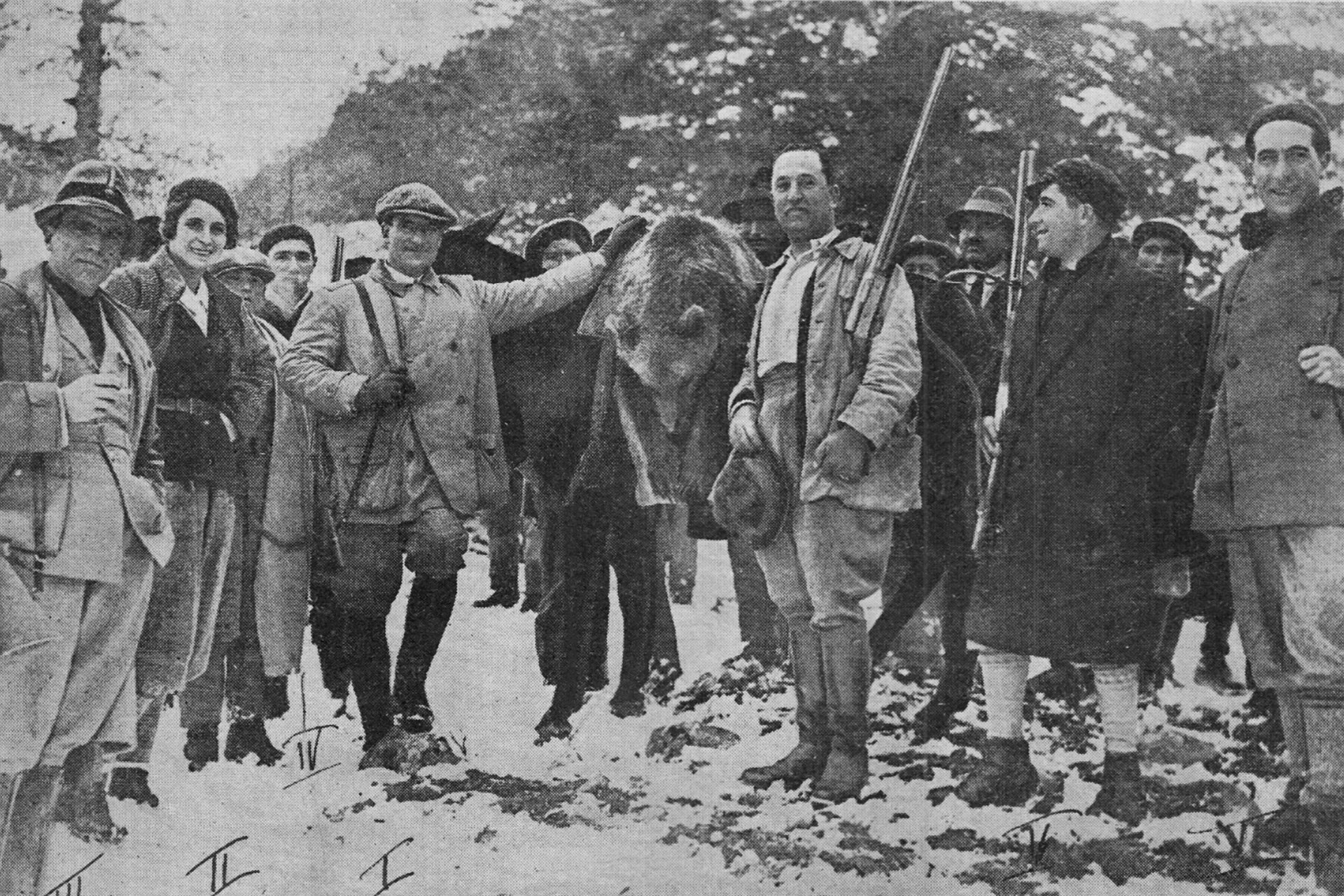
Historical photograph of local notables and officials at the last official bear hunt in the Abruzzo National Park, 1931 | © Archivio Wildlife Adventures | © Archivio M.Mancini – Campobasso

From transhumance to the House of Savoy: the Sipari family and the birth of the National Park

It was precisely from this crisis — and from the awareness that the territory had lost its traditional economic vocation without yet having found a new one — that the vision of Erminio Sipari was born. The nephew of those Sipari brothers who in 1872 had ceded to the Royal House the hunting rights over several mountains in the area, Sipari was an engineer, a member of parliament and a man of deep naturalistic culture. He understood before many others that the most precious heritage remaining in Pescasseroli lay neither in the dwindling flocks nor in the ever less cultivated fields: it lay in the intact nature that the crisis had helped to preserve — the bears, the chamois, the last stretches of forest and the silent valleys. On 25 November 1921 the Autonomous Authority of the Abruzzo National Park was established. On 9 September 1922 Italy's first protected area was inaugurated at Pescasseroli. It was the beginning of a new era: that of a village which had built its identity around flocks and drove roads, and which now placed its faith in nature as a collective resource open to all.

For families, Forest and valleys

West of Pescasseroli, just outside the centre, lies a truly unique and enchanted place, one of the best examples of the fascinating mix of nature and culture, so typical of the Apennines.

  • PescasseroliPescasseroli
  • Distance: 5 kmDistance: 5 km
  • 4 Hours4 Hours
  • Height difference: 150 mHeight difference: 150 m
  • 4-15 people4-15 people
  • Difficulty: EasyDifficulty: Easy
Forest and valleys

A day among green pastures and ancient forests, with the option of lunch at a mountain hut. A perfect experience for nature lovers, biodiversity enthusiasts, and those who wish to explore one of the oldest and most fascinating ecosystems in Europe up close.

  • PescasseroliPescasseroli
  • Distance: 12 kmDistance: 12 km
  • 7 Hours7 Hours
  • Height difference: 450 mHeight difference: 450 m
  • 4-12 people4-12 people
  • Difficulty: ModerateDifficulty: Moderate

Forest and valleys

In the heart of Abruzzo - a region where nearly half the territory is protected by nature reserves - lies an extraordinary arboreal heritage: more than seventy monumental trees, true living symbols of a millennia-old history.

  • PescasseroliPescasseroli
  • Distance: 12 kmDistance: 12 km
  • 7 Hours7 Hours
  • Height difference: 460 mHeight difference: 460 m
  • 4-12 people4-12 people
  • Difficulty: ModerateDifficulty: Moderate
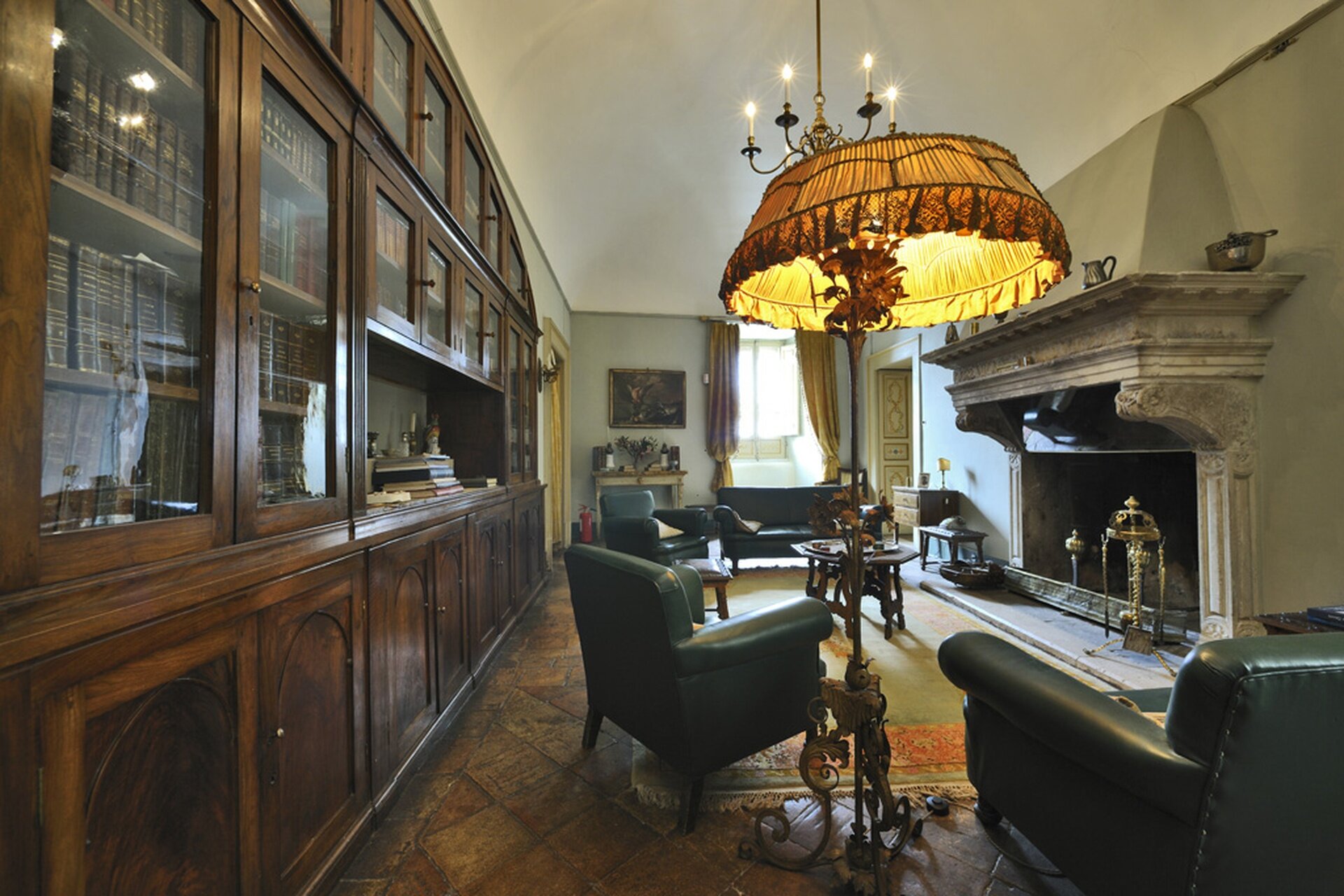
The historic library of Palazzo Sipari in Pescasseroli, with its original wooden bookcases, carved stone fireplace and 19th-century floor lamp | © Archivio Fondazione Sipari

Pescasseroli: what to see in the historic centre

Palazzo Sipari

In the historic centre of Pescasseroli, overlooking the square that today bears the name of Benedetto Croce, stands the palazzo that more than any other tells the story of this village and of how the Abruzzo National Park came to be.

Palazzo Sipari was built in 1839 by Pietrantonio Sipari — a wealthy landowner, a prominent figure of the new livestock-farming bourgeoisie and one of the most important protagonists of the transhumance system in the Alto Sangro — on the site of an older baronial residence acquired from the Massa di Sorrento family, feudal lords of Pescasseroli. The building, which covers approximately 1,000 square metres across four floors, has a late Renaissance architectural character refined by elegant classical detailing, and was declared of particular artistic and historical interest by the Italian Heritage Authority in 1967.

For over 150 years, until 2006, the palazzo was continuously inhabited by the Sipari family. Within these walls stories unfolded that shaped Italian culture and politics: on the second floor, on 25 February 1866, Benedetto Croce was born — the philosopher who would become one of the foremost interpreters of Italian intellectual life between the nineteenth and twentieth centuries — the son of Luisa Sipari and the Neapolitan Pasquale Croce. The palazzo also received members of the Royal House, including Vittorio Emanuele III and the Duke Amedeo d'Aosta, visiting the area of the Royal Reserve. It was here that Erminio Sipari built the political networks that would lead to the founding of the Park.

From 2005, at the wish of the Marchioness Maria Cristina Sipari — the last descendant of the family — the palazzo became a house museum open to the public. The guided tour leads through the rooms in which the family lived their daily lives: the sitting room with its lit fireplaces, the library with its original wooden fittings and the historical archive listed by the Heritage Authority, and the room in which Benedetto Croce was born. Opposite the palazzo, in the former Sipari stables, is the Historical Museum of the Abruzzo, Lazio and Molise National Park. The Fondazione Erminio e Zel Sipari today manages the palazzo and promotes cultural activities, research and the Premio Erminio Sipari prize for nature writing and conservation.

Guided tours take place by appointment — visitors are advised to check the updated calendar on the Fondazione Sipari website.

The church of Santi Pietro e Paolo and the Black Madonna dell'Incoronata

At the edge of the historic centre of Pescasseroli, the church of Santi Pietro e Paolo is the oldest place of worship in the village and one of the most significant Romanesque monuments in the Alto Sangro. Its history predates the year 1000: the original building was constructed over an earlier Benedictine monastic cell dedicated to Saint Paul, probably connected to the abbey of Montecassino or San Vincenzo al Volturno. The earliest documentary evidence dates to 1115, in a papal bull issued by Pope Paschal II.

The earthquake of 1349 razed the structure to the ground; it was rebuilt in the late Abruzzese Gothic style, with cross vaulting and ribbed arches — an architectural language reflecting the influence of the great medieval building sites of the region. A subsequent earthquake destroyed part of the façade and the apse, which were rebuilt in the late Renaissance style, at which point the name of Saint Peter was added alongside that of Saint Paul. The bell tower, erected in 1578 and restored in 1747, rises to the left of the façade with its characteristic round-arch openings for the four-bell chamber. The twentieth-century restoration, carried out following the damage of the 1915 Marsica earthquake, removed the Baroque additions of the seventeenth and eighteenth centuries and brought back to light the fifteenth-century architectural lines. The lunette above the main portal was carved by the local craftsman Ermenegildo Di Pirro.

Inside, among the works of art preserved there, the most notable is the wooden statue of the Black Madonna dell'Incoronata — originally kept in the area of the medieval castle and later transferred to the parish church. The dark-toned statue depicts the Virgin holding a globe in her right hand and the Christ Child in her left arm. According to some traditions, the Black Madonna arrived in Pescasseroli by way of the Pescasseroli–Candela drove road, brought by monks fleeing persecution; others consider it a work of the French school of the fifteenth century. Venerated by communities as far afield as Campania and the Ciociaria, it underwent a full restoration in 1998 that recovered its original polychrome finish.

The ruins and viewpoint of Castel Mancino

Above the historic centre of Pescasseroli, on the summit of the Colle del Castello between 1,275 and 1,332 metres above sea level, stand the remains of what for almost four centuries was the political and defensive heart of the Alta Valle del Sangro: the medieval ring-castle that the shepherd-poet Cesidio Gentile was the first, in the twentieth century, to call by the name it still carries today — Castel Mancino.

Built between the 10th and 11th centuries by the Borrello family, lords of the feudal estate, it was designed to control the valley pass and defend the population from Saracen and Magyar raids. At its peak the castle featured a rectangular keep and a substantial curtain wall with five watchtowers — an imposing and virtually impregnable structure. Around it grew the original nucleus of the settlement, then known as Serule, from which the village would eventually take its name.

The castle passed through many hands over the centuries: from the Borrello to the Di Sangro (12th century), from the D'Aquino (1283) to the D'Avalos (1452), and finally to the Massa di Sorrento family (1705), the last feudal lords of Pescasseroli until the abolition of feudalism in 1806. It was above all the earthquake of 1456 that accelerated its deterioration, and as power gradually shifted to the village below there was no longer any reason to maintain it. From the seventeenth century onwards it fell into steady abandonment, until it became the ruin it is today.

Francesco Saverio Sipari — poet and ancestor of Erminio — was so moved by the sight of it that he devoted some of his most celebrated verses to its memory: «Those old walls of the Castle, that hang silent over my homeland... Dusted with the centuries, those ruins smoulder».

Castel Mancino can be reached on foot from the centre of Pescasseroli along trail B3 of the National Park: from Corso Plistia, take Via Castello and after roughly 350 metres follow the path that climbs through a black pine forest to the ruins — a walk of 20 to 30 minutes. Along the way it is not unusual to spot red squirrels and woodpeckers. At the top, beyond the ruins themselves, a panorama unfolds across the entire Pescasseroli valley, Monte Marsicano and the beech forests of Macchiarvana.

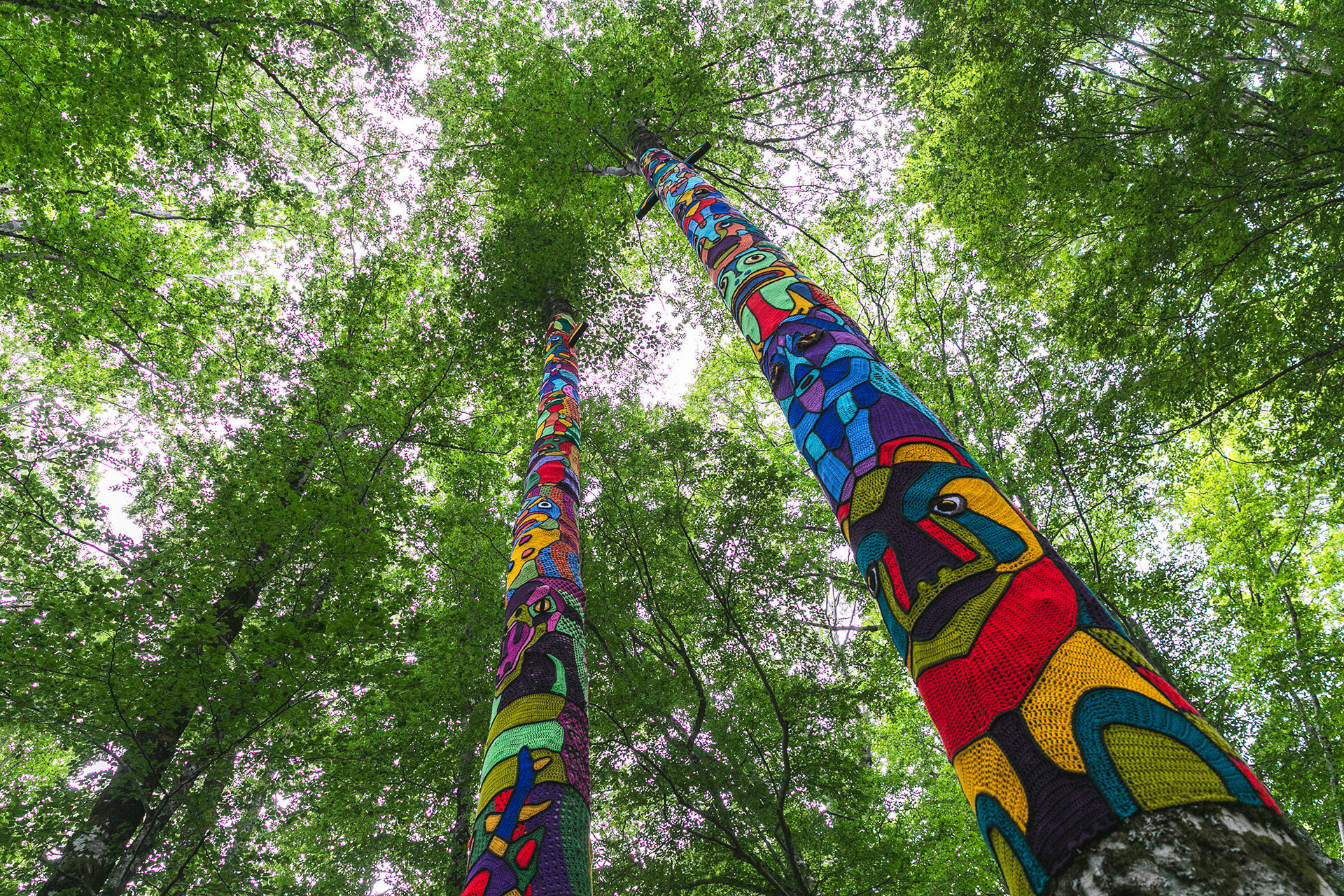
Two beech trees in the Difesa di Pescasseroli wrapped in colourful textile installations, part of the ArteParco open-air contemporary art museum in the Abruzzo, Lazio and Molise National Park | © Luca Parisse - ArteParco

Pescasseroli: recommended trails

ArteParco and the woodlands of the Difesa di Pescasseroli

Within the Difesa di Pescasseroli, along trails C1 and C2 of the National Park, something unexpected awaits: an open-air museum that since 2018 has brought contemporary art every year into the heart of one of the most distinctive beech forests in the area.

ArteParco is a project born from an idea by Paride Vitale, developed in collaboration with the Abruzzo, Lazio and Molise National Park, the Municipality of Pescasseroli and the brand Parco1923, under the patronage of the Italian Ministry of the Environment. The principle is as simple as it is original: each year a different artist is invited to create a permanent installation within the forest, working with natural materials and entering into dialogue with the surrounding landscape. The works are not set apart from nature — they become part of it, entrusted to the cycles of the seasons and the action of time.

Walking the ArteParco trail is a double experience: you move through one of the most distinctive woodlands in the Apennines and find yourself, almost without noticing, confronting questions about humanity, nature and time. It is an experience suited to any kind of visitor — you do not need to be an art enthusiast to be caught off guard by an installation emerging from between the trunks of a centuries-old beech tree.

The trail is open all year round: on foot in spring and summer, and on snowshoes in winter.

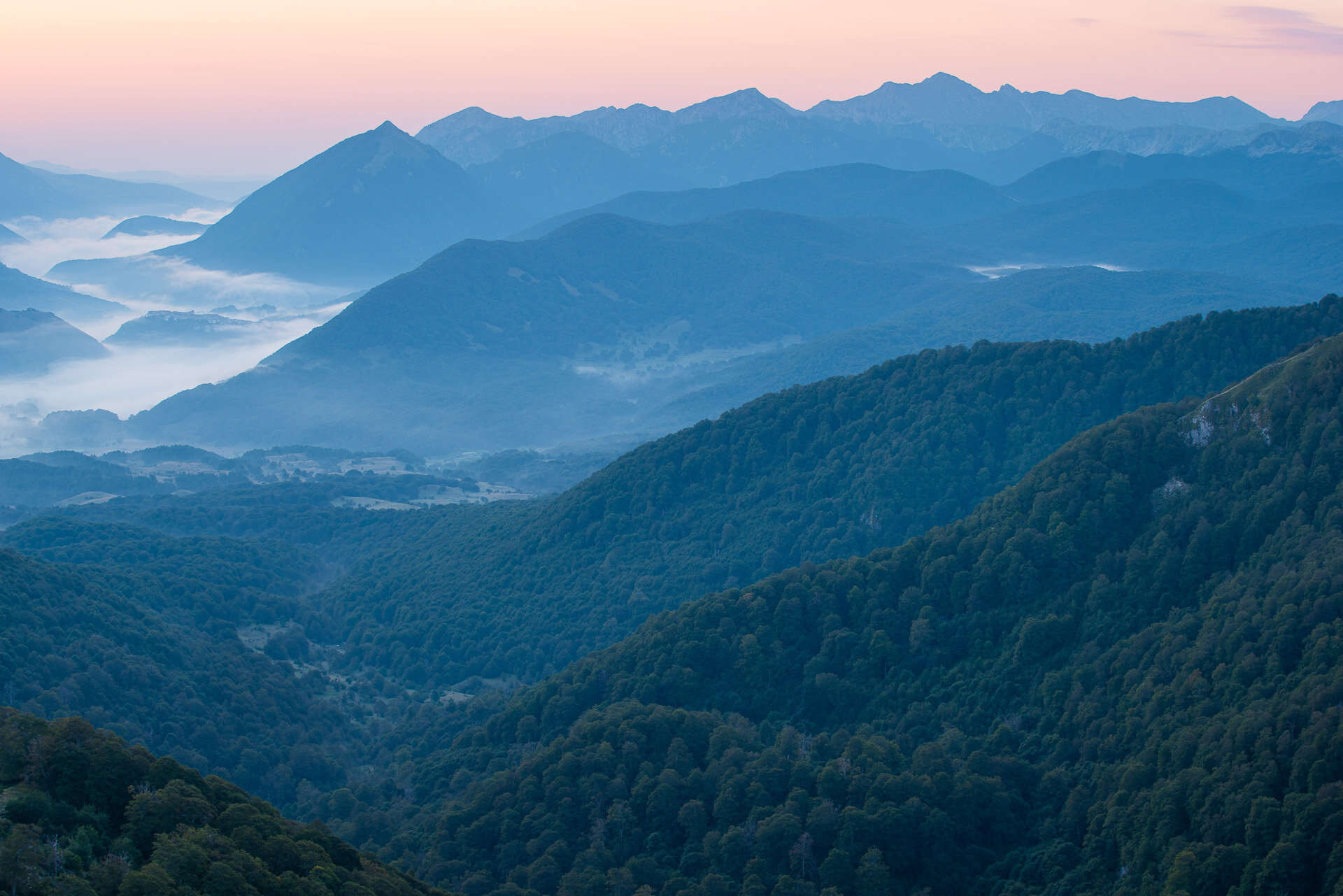
An endless succession of beech forests and mountain ridges wrapped in morning mist in the heart of the Abruzzo, Lazio and Molise National Park | © Umberto Esposito - Wildlife Adventures

From Pescasseroli to the Sanctuary of Monte Tranquillo

About 10 kilometres from Pescasseroli, at 1,597 metres above sea level on the mountain pass that marks the border between Abruzzo and Lazio, stands one of the most silent and profound places in the Abruzzo, Lazio and Molise National Park: the Sanctuary of Santa Maria di Monte Tranquillo.

Its history is as old as the village itself. Built in the early twelfth century at the wish of the Bishop of the Marsi, Saint Berardo — serving the same purpose as the other pass sanctuaries that dotted the network of paths and drove roads across the Central Apennines — it originally functioned as a shelter for pilgrims and travellers crossing the pass between the Abruzzo valleys and the Lazio side of the mountains. By 1324 it was already listed among the churches of Pescasseroli paying tithes to the Diocese of the Marsi. In 1606 it passed under the management of the parish church of Santi Pietro e Paolo, and in 1644 a local physician, Loreto Pastore, built an adjoining hospitale for the reception of travellers.

The sanctuary houses another image of the Black Madonna — the original statue was stolen in 1980 and replaced in 1982 by a copy donated by a devotee. Mentioned by Benedetto Croce in his History of the Kingdom of Naples, severely damaged during the Second World War when the Gustav Line ran through these territories, it was rebuilt in 1956 by the people of Pescasseroli in fulfilment of a vow made to the Madonna during the bombardments — a prayer that the village might be spared.

Every year, on the last Sunday of July, a procession sets out from the church of Santi Pietro e Paolo and makes its way on foot — or on horseback — along the trails of the Park to the Sanctuary: a journey of some ten kilometres through the Difesa di Pescasseroli, among monumental beech trees, open pastures and great white boulders covered in moss. It is one of the most deeply felt celebrations in the Pescasseroli community, in which the ancient bond with the mountain and the cycles of the agro-pastoral world survives intact.

The trail leading to the Sanctuary — route C3 of the Park, also accessible as a circular variant from the C1 trail of the Difesa — is among the finest in the area: the panorama from the summit of Monte Tranquillo (1,841 m) takes in Monte Marsicano, Monte Petroso, the beech forests of Macchiarvana and, on clear days, extends as far as the Lazio side of the Park.

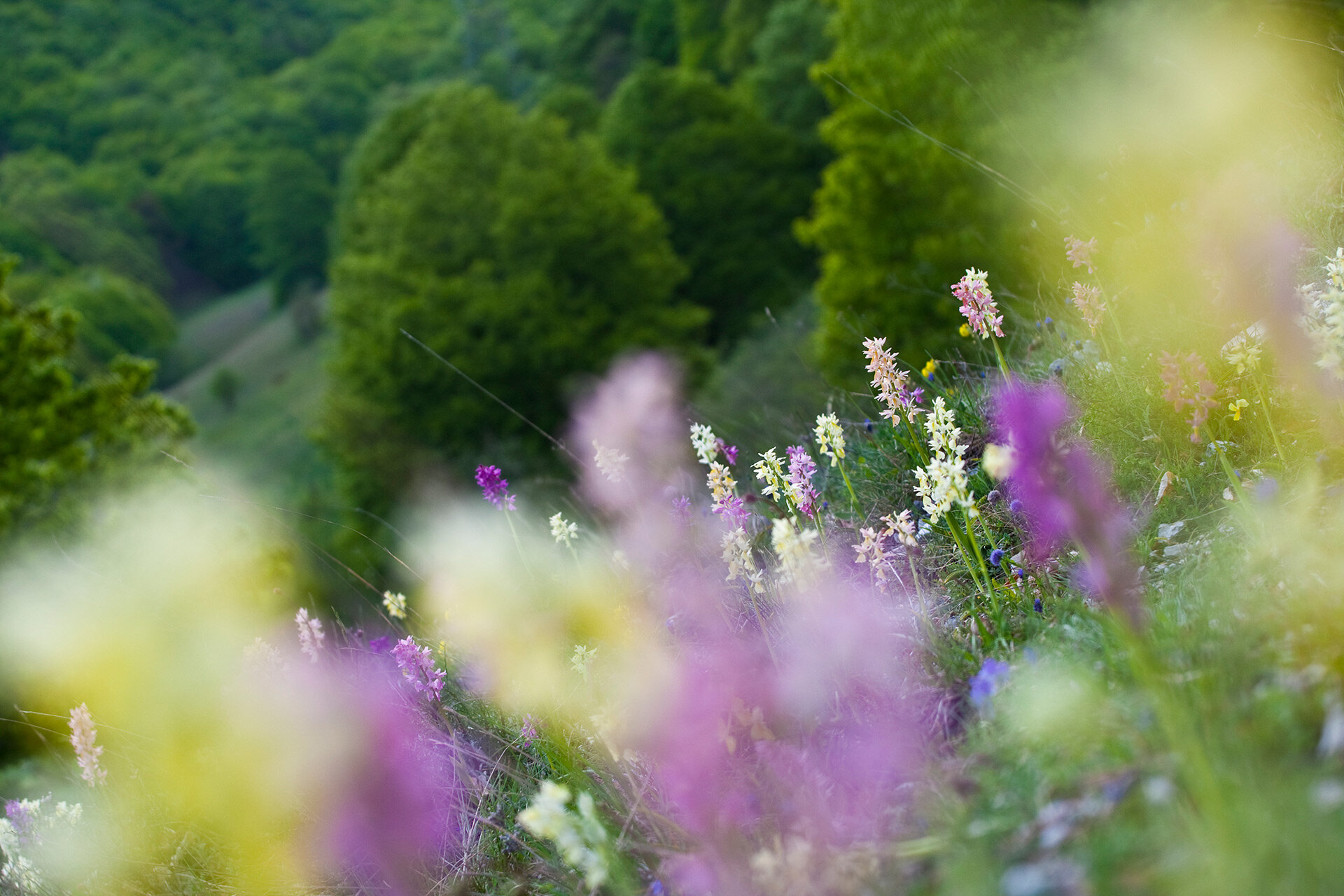
Ebike Terraegna Abruzzo Fioriture

The Valle di Terraegna and the UNESCO World Heritage Forests

To the north of Pescasseroli, climbing the slope opposite the Difesa along trails Z1 and A1 of the National Park, lies one of the most remote and silent landscapes in the entire Central Apennines: the Valle di Terraegna, a karst plateau at 1,780 metres above sea level, nestled between the foothills of Monte Marsicano to the south and Monte Palombo to the north, at the foot of the long ridge of the Montagna Grande.

The walk from Pescasseroli — which sets out from the eastern edge of the village along trail A1 of the Park and the Canala di Prato Rosso — covers approximately 12 kilometres with 450 metres of ascent, following an intermittent stream through open clearings and increasingly dense and imposing beech woodland. The route takes around 5 hours in total and is suited to walkers with a good level of fitness.

Those wishing to reach the Terraegna Refuge and the upland plateau without tackling the full walk from Pescasseroli can take a shorter but equally rewarding alternative: trail Z1, which starts from the locality of Templo, roughly halfway between Pescasseroli and Bisegna along the road that climbs northward.

The path begins at the lay-by just before the trail entrance — where cars can be left — and climbs the Vallone Filarello through open pastures and beech forest up to the Terraegna plateau and the refuge. Compared to the route from Pescasseroli it is a more direct itinerary: 6.7 km in length, 434 metres of ascent, estimated duration 2 hours.

As you climb, the landscape changes: the beech trees grow larger, more twisted, more silent. Some of these trees are over 500 years old — alive before the end of the Middle Ages, before Christopher Columbus reached the Americas. They have been recognised not only as the oldest beeches in Europe but as the longest-lived broadleaved trees in the entire northern hemisphere, and in 2017 these ancient forest nuclei were inscribed on the UNESCO World Heritage List as part of the serial site Ancient and Primeval Beech Forests of the Carpathians and Other Regions of Europe.

Guided excursions from Pescasseroli

With Wildlife Adventures we organise guided experiences throughout the year in the Abruzzo, Lazio and Molise National Park, with Pescasseroli as the ideal starting point for exploring forests and panoramic ridgelines. From family-friendly walks to more demanding days out, we accompany you through the territory at the right pace — reading the landscape and keeping safety always at the fore.

If you are planning a longer stay, take a look at our tailor-made private tours: we build the programme together based on your interests, the time you have available and the kind of experience you are looking for — whether that is wildlife watching, nature photography or e-biking through the villages of the Alto Sangro.

Scheduled hikes in Pescasseroli

Stay up to date with the latest news by signing up to the Wildlife Adventures newsletter.

Thank you

LBL_MAILINGLIST_CONTROLLA_EMAIL_ATTIVAZIONE

Something went wrong

Please try again

Close

Newsletter subscription